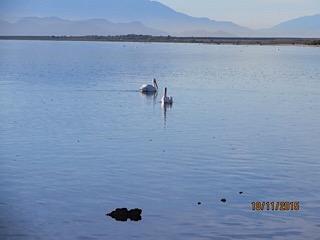
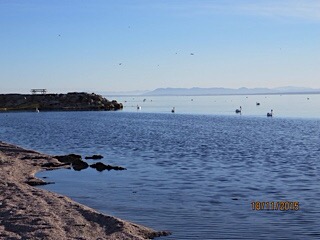
For thousands of years, during sporadic flooding, water flowed into the Salton Sea basin, an inland lake in southern California. Then, after each flooding, over long long periods of drought, it would mostly evaporate. The last great flood here was in 1905, when the Colorado river broke through the irrigation canals and the flooding lasted for a year and a half. Since then, it’s been pretty much evaporating. The result is a much smaller, lower lake now, with a very high salt density. Nothing like the density of the Dead Sea, or the Great Salt Lake, but still, twice that of the pacific ocean. Strangely, the talapia, a fresh water fish from Africa, has thrived in these conditions, since its introduction here. Apparently, over 400 million talapia inhabit this lake. Happy days for the many birds who flock here, to feast on this abundance. At times, the wind can stir up the organic material on the lake bed, resulting in pockets of low or zero oxygen in parts of the lake. This kills off the fish in those pockets and so, around the shoreline, hundreds of dead fish are to be seen lying on the sandy rim. If you don’t spot them as you approach, you’ll certaintly smell them. The place has an eerie emptiness about it, and yet is very beautiful. I’m told, that at times, it can be full of swimmers, boaters and fishermen. Today, there is just the two of us, a couple of Canadian tourists, and many dead talapia.
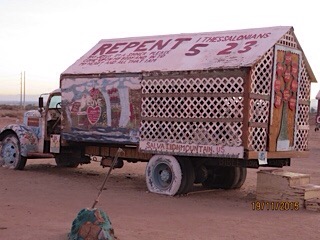
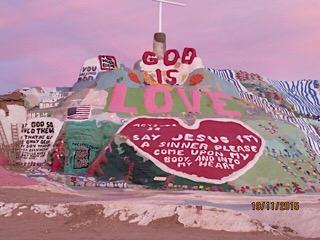
A short drive away is Slab City, a collection of camper vans and mobile homes, gathered in the desert. People live here in what seems like isolation from the twenty first century. They bring in their water, from where, I have no idea. They have no mains power, no shops, no McDonalds, no Dunkin Donuts. Just themselves and the desert. To this place, in 1980, came Leonard Knight. He lived in his old van and his aim was to build a mountain in praise of god. The result -Salvation Mountain. Built of bales of straw, clay and paint. He spent twenty eight years on what is really a never-ending project. He died in 2014, but his work, which in 2002 was proclaimed a national treasure, is still cared for by volunteers.
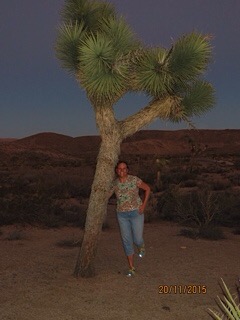
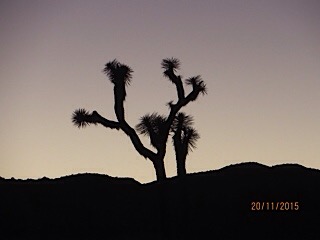
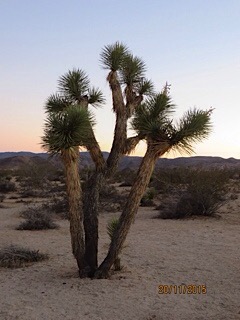
It is not far from Salvation Mountain to Joshua Tree National Park. I always thought that this was just a tree, or perhaps a park based around a tree. Not so. Joshua Tree National Park is vast. It spans the meeting of the Colorado and Mojave deserts. On the northern side, grow the joshua trees, and plentiful they are. They are not beautiful, (well probably, parent joshua trees think they are beautiful), but they are striking. They are unique to this general area which stretches a little further northward with the Mojave desert.
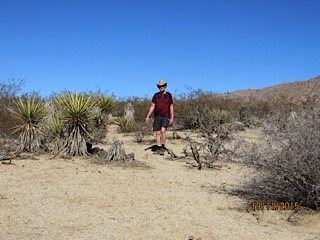
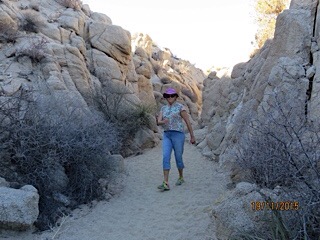
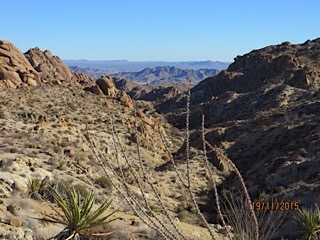
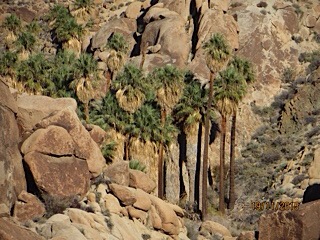
The southern side of the park is where we go hiking. Our way is across the desert, over a stoney, sandy trail, dry as a bone, with scrubby bushes on either side. There is no great climbing or scrambling, but it rises and falls over the tops of bare knolls and the bottoms of narrow rocky canyons. We hike for a couple of hours to a spot called “Lost Pines Canyon”. A small oasis of pine trees, that seem to rise from the depths of the earth, in an effort to reach the sunshine above the canyon walls. Time for a water break and a snack, before the return to the car. The sun sets quickly in this part of the world, and it is quite dark, long before we drive out of the park gates.
 mrbrianking